Logistica

Logistica

A village under glass

A deck-builder. Cards cost people. Every tile you clear brings a bigger raid.

The case

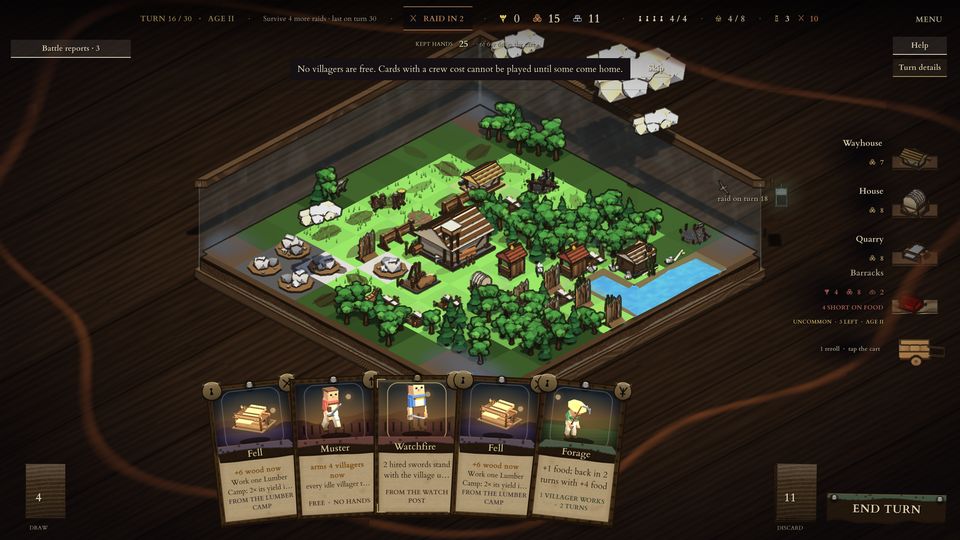
A medieval village grows inside a sealed glass case on a naturalist's bench.

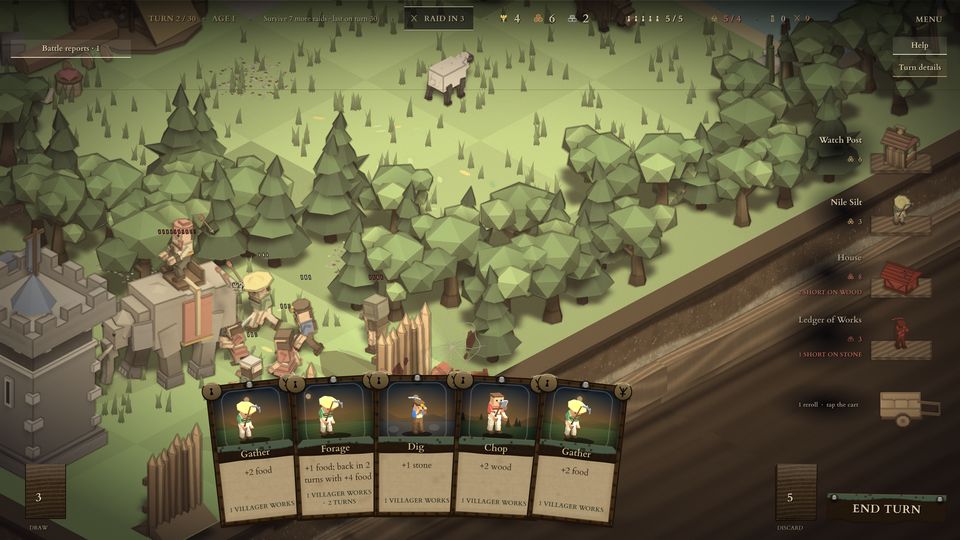
You never order a villager around. You play cards, and villagers are what the cards cost. Each one you spend walks out across the board, does the work, and comes home a turn later.

Villagers you do not spend widen your hand next turn, so a card held back is worth part of a card later.

The case at a slight tilt, a village mid-run under glass, the hand of cards resting against the front pane
Drag the glass to turn the case. The hand rests low against the front pane and rises to meet the pointer.

Buildings are cards

Every building in your deck is a one-shot card. Place it and it leaves the deck for good, so raising your village is also how you thin it.

What goes back into the deck comes off the board. A Farm hands you Harvest. A Lumber Camp sends Fell, a Tower sends Muster, a Smithy sends Hired Swords. If a raid burns that building down, the card it gave you leaves the deck from wherever it is sitting.

The market is a rack of shelves at the side of the case, and it sells things rather than cards. A building bought there goes straight onto a tile. What the shelves stock depends on what already stands in your village. No Smithy, no Hired Swords.

The deck laid out on the bench, cards fanned by age
The deck, spread on the bench. Cards of a later age carry that age's dye in their wood.
The market shelves beside the case with a hand cart for the reroll
Six stalls, one reroll a turn, and the ink tells you how many of a rare thing are left.

The board is the other half

Each tile is a 3×3 grid of smaller cells, so footprints straddle tile borders and neighbours matter. Mills boost the farms beside them. Palisades stiffen each other. A Gate is worth more with wall on both sides. Trees block the cells they stand on and leave the gaps buildable. Docks want water, quarries want stone.

Ground outside your start square is locked and fogged until you buy it. Every tile you clear is also a tile the raiders have counted, so growth and threat are the same number. The lantern on the corner post runs from green through ember to red as exposed threat climbs.

Tap a plate to lift it off the bench.

Raiders loot before they burn

A raid measures its threat against your defence, and anything left over is damage. Damage first steals from your largest stockpile, so hoarding carries its own risk. Buildings only start coming down once there is nothing left to take.

Muster puts your idle villagers on the wall, where they die before your buildings do. Play another card after mustering and you have thinned your own line.

The wall holds
Villagers mustered
A ram at the glass
Nothing left to take

Ages

Every village starts with a Town Centre. Pay for the next age and the Builders leave for two turns. When they come home your hand grows, the stalls open a new shelf, and the deck owes a burn: any card, from any pile, out of the run permanently.

Raiders who get past everything else do not burn the Town Centre. They pull it down an age, and the shelves close behind them.

Rise through three ages

The road

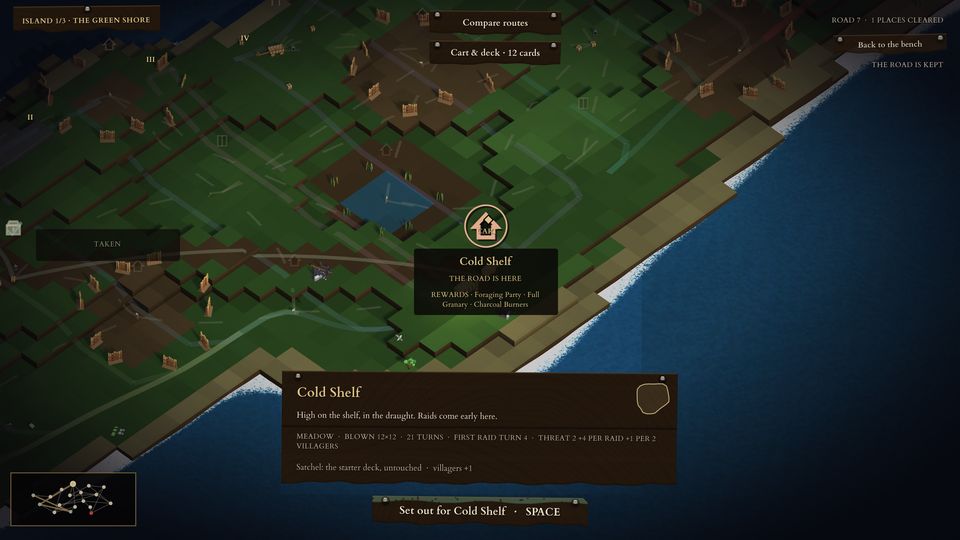
A case is one run. Win it and you go out onto a road across an island you drive yourself. You are the ox cart, and the country around each stop is that stop's own biome.

Each place is a run with its own bed, outline and rule. Raiders wading in off the coast. A quarry already standing. Walls already up. Every edge at once, at the last case. Between places, notes offer a choice of two, and jars hold relics that rewrite the rules of the next run.

Lose a place and the road ends there. Start again and the island is laid out fresh.

The island road with the ox cart at a note on a post
Steer the cart between places and choose which stop to take next.
A desert case
Six board outlines and four biomes, each place scaled to how far along the road it sits.

Watch

Villagers as energy. Cards cost people, not mana. Spent villagers walk out, work, and return a turn later. Unspent ones widen your next hand.

Buildings are one-shot cards. Placing a building removes it from the deck, so construction is deck thinning.

A deck that answers to the board. Buildings put their own boost cards on top of your draw pile. Burn the building and the card goes with it.

A market of things, not cards. Six stalls, one reroll a turn, stock gated by what stands in your village.

Sub-cell placement. Tiles split 3×3, footprints straddle borders, and terrain decides where a building is worth building.

Growth is threat. Every tile you clear counts toward the next raid, and the lantern on the case shows how exposed you are.

Raids that take before they break. Damage loots your biggest stockpile first, then your walls, then your buildings, then your people.

Ages. Pay the Town Centre, lose your Builders for two turns, gain a card in hand and a new shelf of goods, and owe the deck a permanent burn.

A drivable road. An island laid out fresh each campaign, with places, notes and jars in tiers.

Relics in jars. Most rewrite the rules of every run that follows. A few are read by the road itself.

Rarity that means supply. Rare cards have a fixed number of copies for the whole run, and the shelf ink tells you how many are left.

Built to be looked at. Flat-shaded low poly under glass, selectable art looks, and a camera you can orbit and push in on.